
Disputes and Arbitration
Not every market result is uncontested.
Disputes and arbitration exist so that a market does not rely only on an unchallenged proposed outcome when users believe that outcome is wrong or unclear.
Disputes
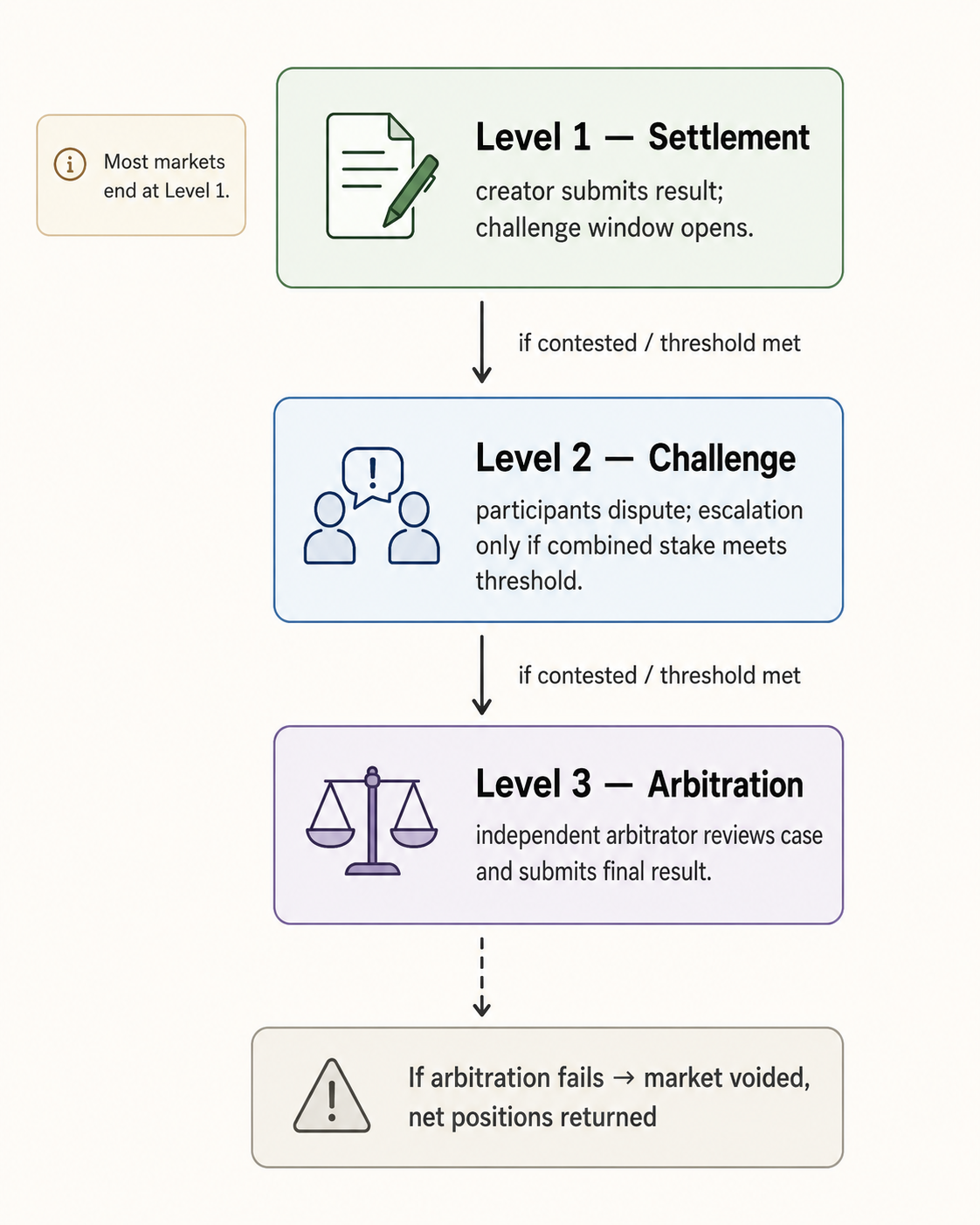
A dispute happens when participants raise a formal disagreement with the proposed result of a market.
From a user perspective, this stage matters because it means:
- the market is no longer in a simple resolution path
- the proposed outcome is being questioned
- the final result is not yet fully settled
Why disputes exist
Disputes are important for trust. Without them, users would have limited protection when a settlement is contested.
They exist to handle cases such as:
- an incorrect interpretation of the result
- unclear real-world evidence
- ambiguity in the rules or event outcome
How to raise a dispute
Participants who hold a position in the market can raise a dispute during the dispute window. There are two ways to do this:
- Go to Portfolio, find the market you participated in, and raise a dispute directly.
- Navigate to the market detail page, select the outcome you believe is correct, and describe why that outcome should be the result.
The dispute registers your disagreement along with the outcome you support. You do not need to put up additional funds — your existing position in the market is what backs your dispute.
How disputes escalate
Disputes are not triggered by a simple majority vote or by reputation. They are triggered by an economic participation threshold.
When participants raise disputes, the protocol tracks the combined position of everyone backing the same alternative outcome. If their combined position in any single outcome reaches 30% of that outcome's pool, the dispute escalates to arbitration. Markets where the threshold is not reached resolve according to the creator's submitted result.
This design means that meaningful disagreement — backed by real participation — is what drives escalation, not volume of complaints.
When the creator misses the settlement deadline
If the creator fails to submit a result within the settlement window, the market enters a free dispute window. During this period, any single dispute — regardless of the participant's position size — immediately triggers arbitration. The 30% threshold does not apply.
This ensures that markets abandoned by their creator still have a path to resolution rather than being automatically voided without recourse.
Arbitration
Arbitration is the stronger fallback path for disputed markets.
It exists for cases where the dispute threshold has been reached and a neutral resolution process is needed.
Users should think of arbitration as a backstop, not the normal default for every market.
Why not every market goes there
Most markets are expected to resolve without heavy escalation. Arbitration exists because edge cases matter, not because every market should be hard to resolve.
That distinction is important:
- a market system without arbitration can break in contested cases
- a market system that needs arbitration for everything is poorly designed
Tracking disputes and governance
Markets that enter a dispute or arbitration path can be tracked on the Governance page. From there, you can see the current state of markets relevant to you — and navigate to the detail page to raise a dispute or submit evidence.
What users should expect during a dispute
During a dispute or arbitration path:
- the market is still resolving
- claims may not yet be available
- the final outcome should be treated as pending
Why this matters for user trust
A strong prediction market is not only about active participation. It is also about what happens when users disagree.
Disputes and arbitration are part of Signa’s trust model because they define how contested outcomes are handled instead of ignored.