
Voided Markets
A voided market is one where the protocol cannot assign a valid final outcome. Instead of declaring a winner, the market returns funds to participants.
Void is not an error state. It is a deliberate safeguard: Signa would rather return funds than force an outcome that cannot be honestly determined.
When a market may be voided
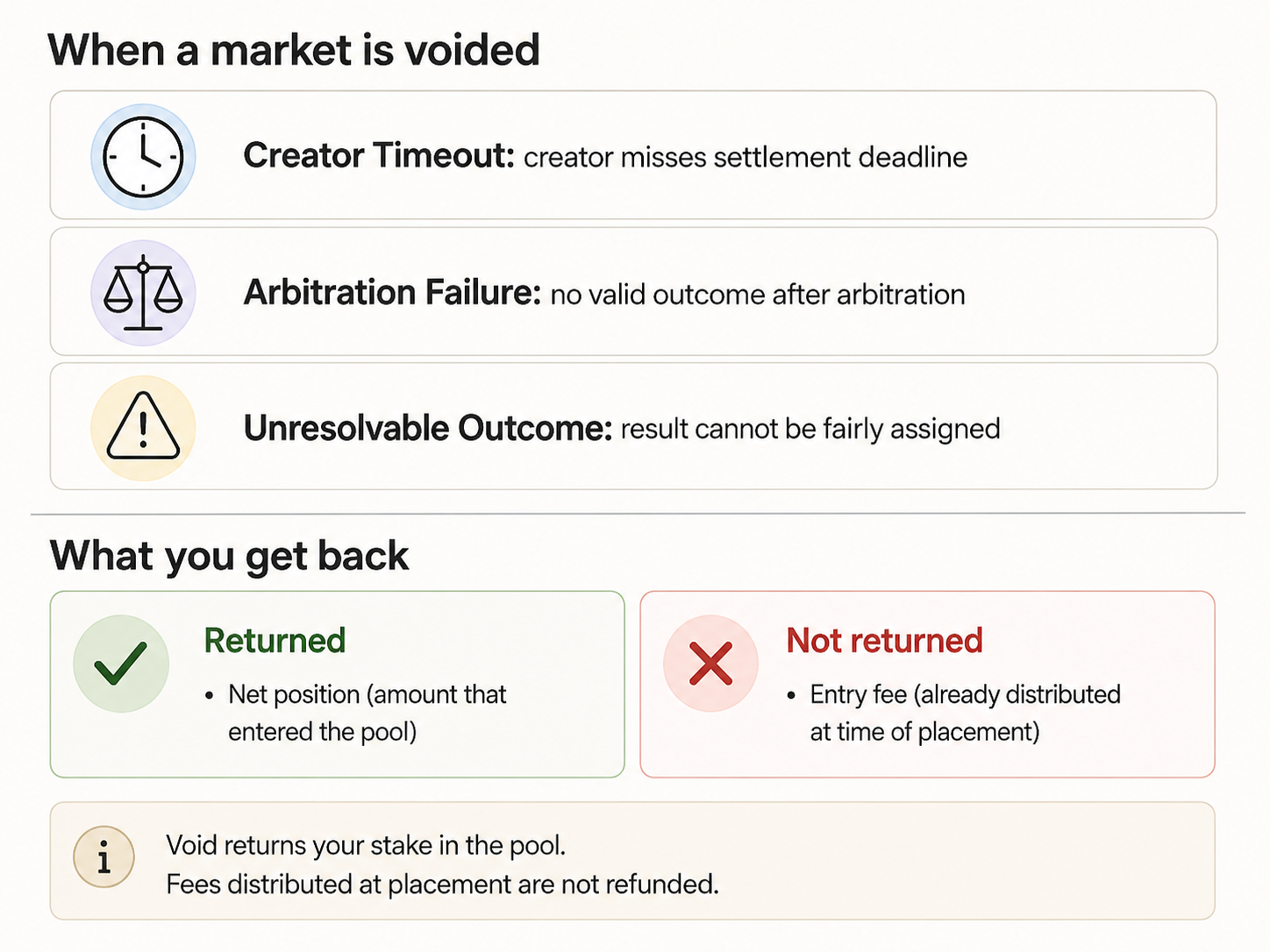
There are three main paths to a void outcome.
Creator timeout. If the market creator does not submit and lock a settlement result within the required time window, the protocol automatically voids the market. This is the most common reason a market ends in void. The creator's accumulated earnings are forfeited, and all participants receive refunds.
Arbitration cannot produce a result. If a disputed market enters arbitration and the arbitration process ends without a valid outcome — for example, if the arbitration deadline expires before a result is submitted — the market is voided as a final fallback.
Outcome is genuinely unresolvable. In rare cases, the real-world event makes it impossible to assign a clean result under the market's rules, and the resolution process concludes that voiding is the only honest path.
What you get back
When a market is voided, each participant's net position is returned to them.
The net position is the amount that actually entered the pool after the entry fee was deducted at the time of participation. Entry fees are distributed at the point of each transaction — they fund creator rewards, referral rewards, and the protocol's arbitration reserve — and are not returned as part of a void refund.
In short: you get back the capital that was in the pool. You do not get back the portion that was allocated as fees when you placed your position.
How the refund works
Void refunds follow the same claim path as normal market outcomes. The market must reach a finalized state before any funds can be claimed.
Once the market is finalized:
- any participant who held a position in the market can claim their refund
- the refund amount corresponds to their total net position across all outcomes in that market
- no winner tax applies — void refunds are straightforward returns of principal
There is no separate refund process. The same claim action covers both winner payouts and void refunds, with the result determining which applies.
Why void exists
A prediction market's value depends on the trustworthiness of its outcomes. Forcing a result when the real-world event is ambiguous, the creator has failed to act, or arbitration cannot reach a conclusion would undermine that trust.
Void exists so that the protocol has a safe exit: when a clean answer is not available, participants get their capital back. No one loses money to an unresolvable question.