
Why Signa?
Prediction markets work. Decades of research have shown that well-designed prediction markets consistently outperform polls, expert panels, and algorithmic forecasts at producing accurate probability estimates. When people must back their beliefs with real capital, the price that emerges reflects not what is popular, but what is likely to be true.
The problem is not that prediction markets are ineffective. The problem is that they have been available only to the few. Three barriers have kept them that way.
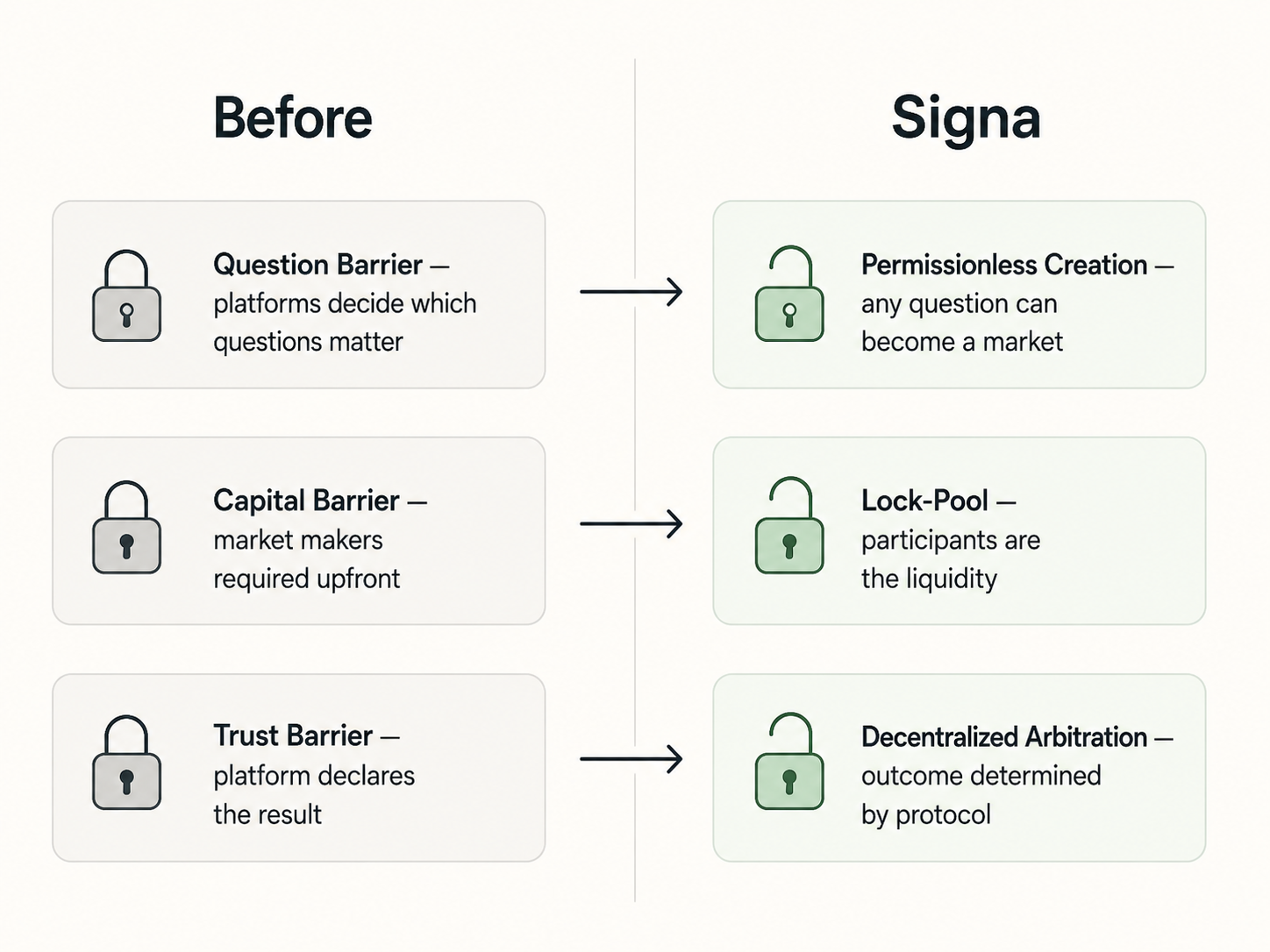
The question barrier
Existing platforms decide in advance which questions are worth asking. Elections. Interest rates. Major sporting events. These matter — but they represent a fraction of what people actually wonder about.
The long tail of human curiosity goes unserved: local events, community debates, niche markets, fast-moving topics. Any question that is not commercially viable enough for a platform to curate simply does not get a market.
Signa removes this barrier through permissionless creation. Anyone can launch a market. The protocol does not screen questions for relevance or commercial potential. If the question is clear and the outcomes are verifiable, it can exist.
The capital barrier
Markets need liquidity to function. In traditional prediction market systems, someone must provide it upfront — a platform, a market maker, or a sponsored liquidity provider. This means only questions with enough institutional interest behind them get funded. Small questions, personal questions, and niche questions are priced out before they begin.
Signa removes this barrier through lock-pool liquidity. There are no market makers on Signa. Every position placed by a participant is locked into the pool, and the pool itself is the prize. The participants are the liquidity. A market with two participants has a pool. A market with two thousand participants has a larger one. Neither requires external capital to function.
The trust barrier
When a market resolves, someone must declare the outcome. In centralized platforms, that someone is the platform itself — a single point of trust, and a single point of failure. When the result is ambiguous or contested, users have limited recourse. They must trust that the platform got it right.
Signa removes this barrier through decentralized arbitration. Outcomes are not declared by Signa. They move through a staged resolution process: the creator submits a result, participants can raise a dispute, contested markets escalate through an economically accountable arbitration layer, and if no valid outcome can be determined, the market voids and funds are returned in full. Every stage is protocol-enforced and on-chain.
What remains when the barriers are gone
Any question can become a market. Any person with a wallet can participate. Any outcome can be fairly determined — or honestly returned when it cannot be.
That is the design intent. Not a better prediction market for the same narrow set of questions. A prediction market layer that works for the full range of questions people actually have.