
What Is a Market?
A market is the core unit of activity on Signa.
Every market includes four basic elements:
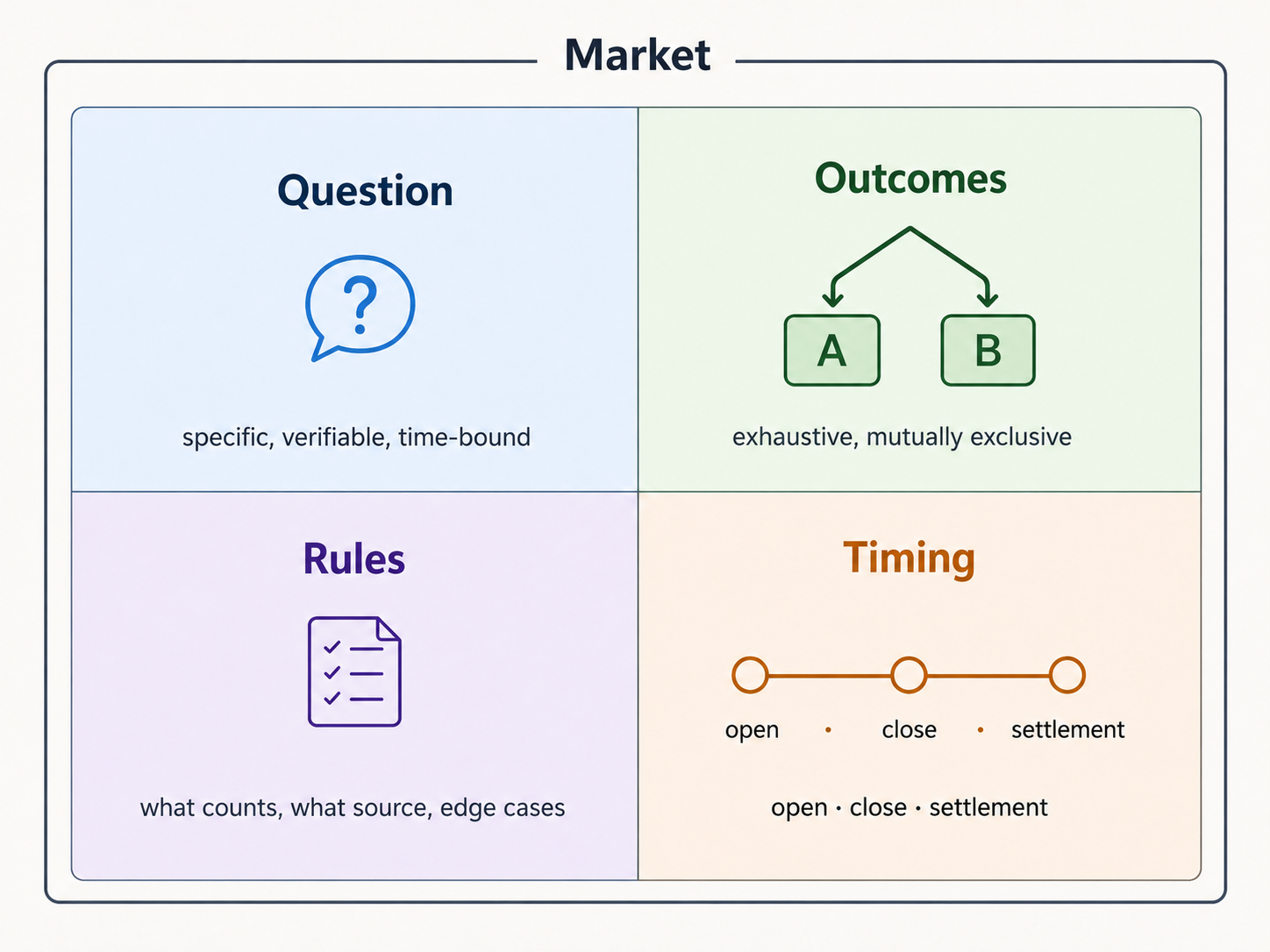
- a question
- a set of possible outcomes
- a rules framework
- a timing framework
The question
The question defines what is being predicted. A good market question is specific, understandable, and tied to something that can be checked against reality.
The outcomes
Outcomes define the possible resolution paths. Depending on the market format, there may be two outcomes or multiple outcomes.
Outcomes need to be clear enough that participants do not have to guess what each option means.
The rules
Rules explain how the final result should be interpreted. This is what helps distinguish a usable market from an ambiguous one.
Rules should answer questions such as:
- what exactly counts as the event happening
- what source or standard should be used if interpretation is needed
- what edge cases should be treated as invalid or void
The timing
Every market also has a time structure, including:
- when participation is open
- when participation closes
- when settlement can begin
These time windows define the transition from active trading to settlement and then to resolution.
What users are actually doing
When users participate in a market, they are not just expressing an opinion. They are taking a position on a defined outcome under a defined ruleset and a defined resolution path.
That is why market quality matters so much: the better the market is framed, the more useful participation becomes.