
Odds, Fees, and Payouts
Understanding how a market prices outcomes, applies fees, and calculates payouts helps you make sense of what you see before entering a position and what you receive after a market resolves.
How odds work
Signa markets use a lock-pool model. There is no fixed odds-setter and no market maker. Instead, the odds at any moment reflect how participation is distributed across the available outcomes.
If most of the pool is concentrated in one outcome, the potential return for choosing that outcome is lower — because you would be sharing the total pool with more capital. Choosing a less-favored outcome carries more risk, but also a higher potential return if it wins.
This means odds are not static. Every new position shifts them. The return you see when estimating a position reflects the pool state at that moment — by the time your transaction is confirmed, the odds will have moved slightly based on everything else that happened in between.
Estimated returns include your own effect on the pool. When the interface shows you an estimated payout, it factors in the dilution your own position creates. This makes the estimate more accurate than simply reading the current odds.
Fees
There are two distinct fee moments. They happen at different times and apply to different things.
Entry fee
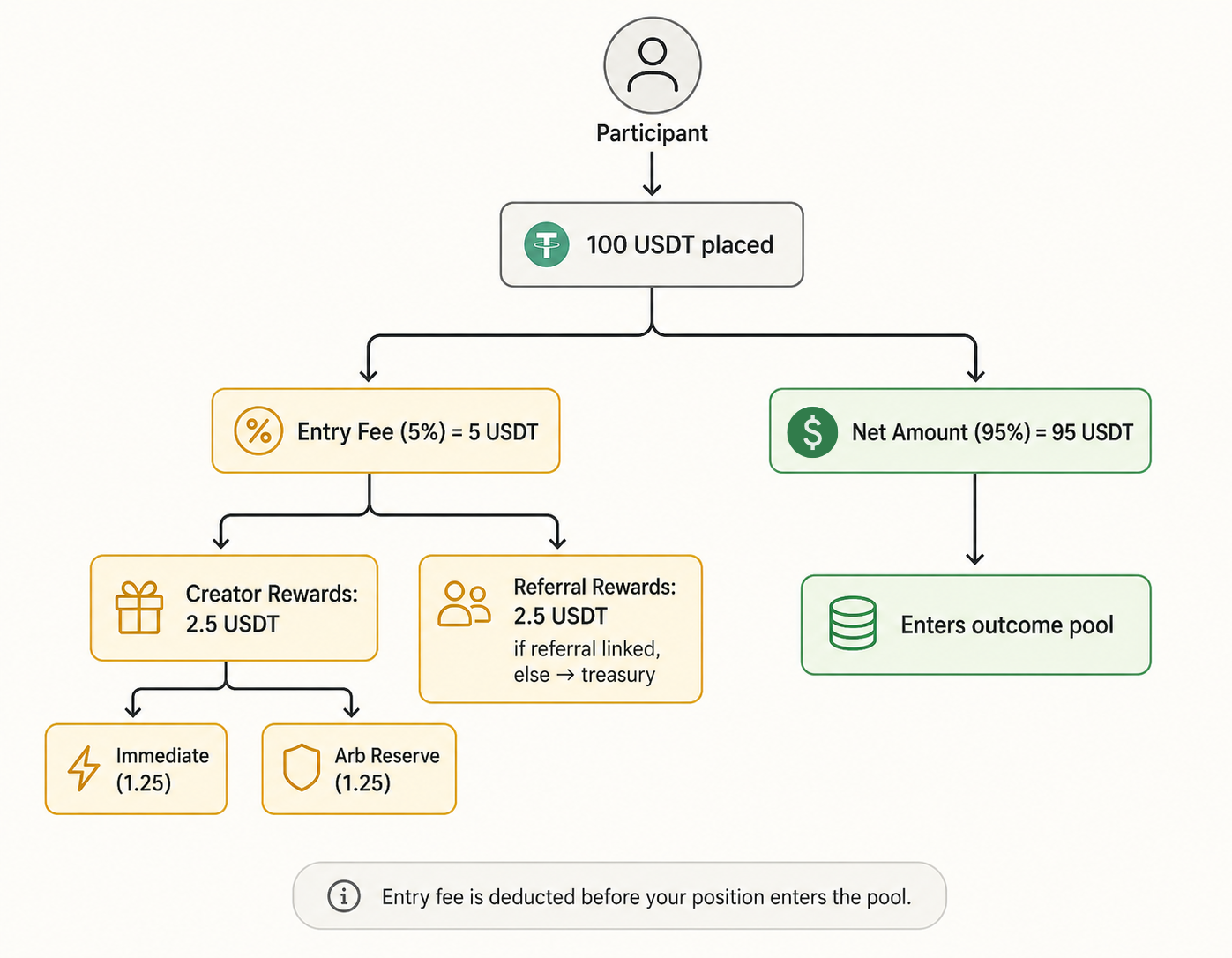
When you place a position, a fee is deducted from your amount before any of it enters the pool. What remains after this deduction — your net position — is what actually counts toward your share of the outcome pool and toward your share of the payout.
The default entry fee is 5% of your position amount. It is distributed at the time of your transaction and split as follows:
- Referrer — 50% of the entry fee (2.5% of your position amount). If you entered the market through a referral link, this portion goes to your referrer. If there is no referrer, it goes to the protocol treasury.
- Creator — 50% of the entry fee (2.5% of your position amount), split into two components:
- Base reward — half of the creator's share (1.25% of your position amount). Locked until the creator submits a settlement result.
- Arbitration reserve — the other half (1.25% of your position amount). Held by the market and returned to the creator after resolution if no arbitration occurs. If arbitration is triggered, the reserve is used as part of that process.
None of the entry fee comes back to you regardless of how the market resolves. The fee parameters are set at market creation and do not change for the lifetime of that market.
Winner tax
If your chosen outcome wins, a 10% tax is applied to your profit — the amount you earned above your net position. Your original net position is not taxed again. Only the gain is.
These are two separate deductions. The entry fee affects everyone who participates, regardless of outcome. The winner tax only applies to participants whose outcome wins, and only to the profitable portion of their return.
How payout is calculated
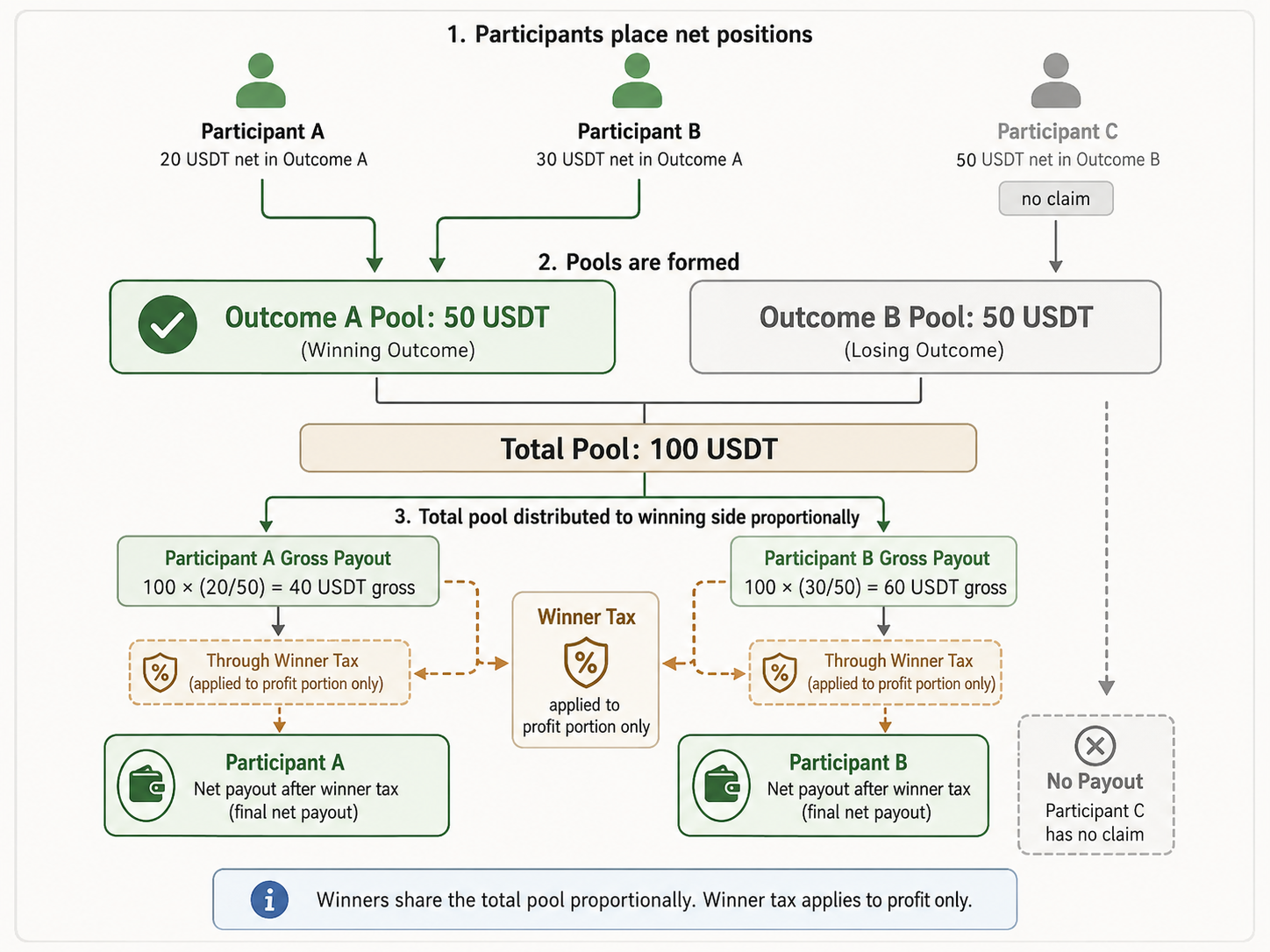
When a market resolves with a winning outcome, the total pool — the combined net positions of all participants across all outcomes — is distributed to the participants who chose the winning outcome.
Your share of that pool is proportional to your net position in the winning outcome relative to the total net position in that outcome.
A simplified example: if the total pool is 1,000 and the winning outcome's pool is 400, and your net position in that outcome is 40, your gross return is 1,000 × (40 / 400) = 100. Your profit is 100 − 40 = 60. The winner tax is applied to that 60. What you receive is 100 minus that tax.
The actual numbers will vary with the market's fee parameters and pool distribution. What stays constant is the structure: proportional share of the total pool, winner tax on the profit portion only.
Void path
When a market is voided, the payout logic above does not apply.
Instead, each participant receives back their net position — the amount that entered the pool, across all outcomes they participated in. There is no winner, no profit, and no winner tax. Entry fees are not returned, as they were already distributed at the time of participation.
Void and resolution with a winning outcome are two distinct paths. Understanding which one applies to a market determines whether you should expect a payout or a refund.