
How Signa Works
Every Signa market follows the same structure: a lock-pool model for participation, and a staged resolution process for determining the outcome.
The lock-pool model
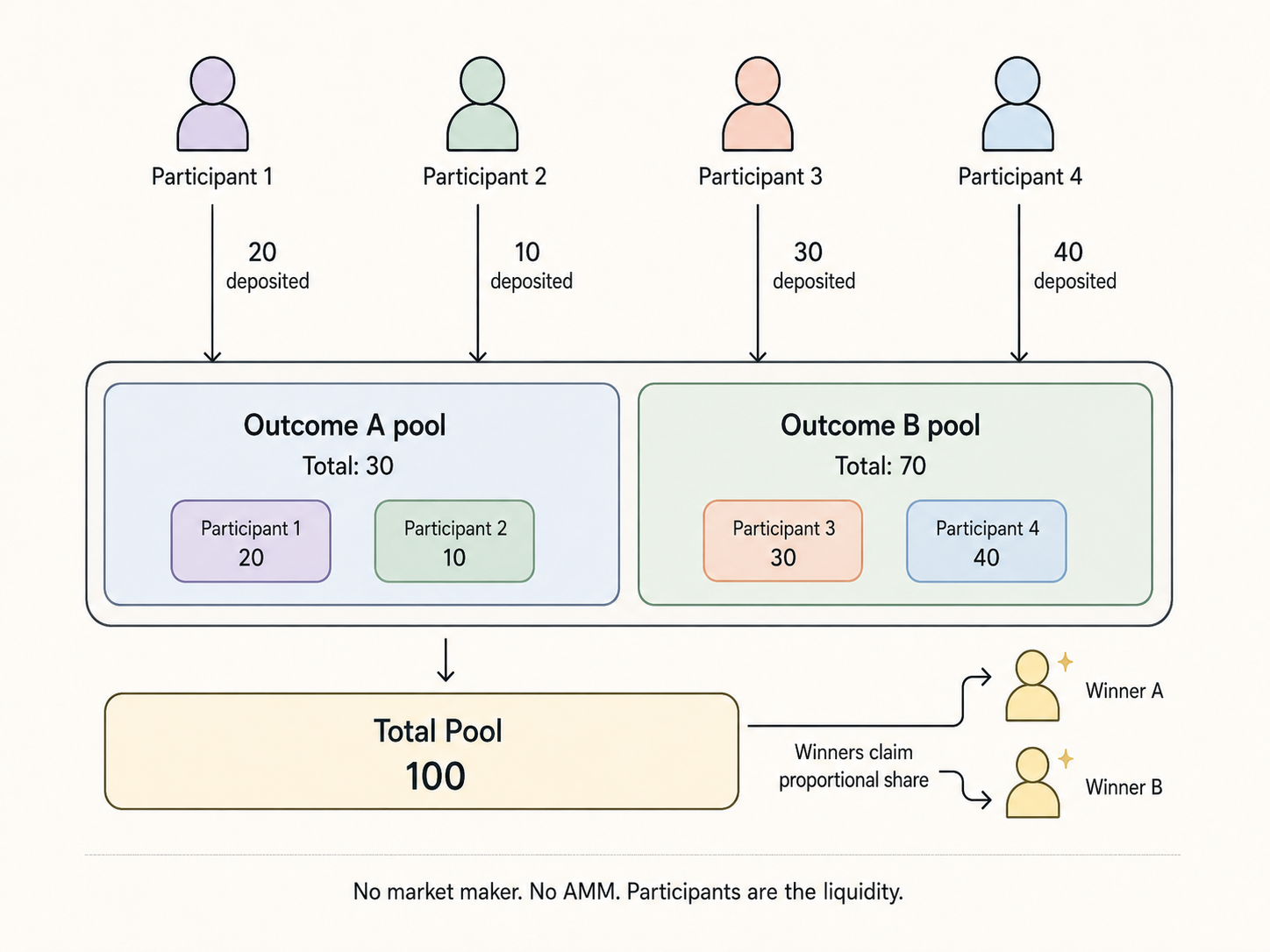
When a participant takes a position in a market, their funds — minus an entry fee — are locked into that outcome's pool. The total pool across all outcomes is what gets redistributed when the market resolves.
There is no market maker setting prices. There is no AMM adjusting a curve. The odds at any moment reflect the current distribution of capital across the available outcomes. More capital concentrated in one outcome means a lower return for choosing it; less capital means a higher potential return if it wins.
The participants are the liquidity. A market's pool is made entirely of what its participants have committed. This is what makes permissionless creation viable — you do not need external capital to open a market, only participants willing to take positions.
The four stages of resolution
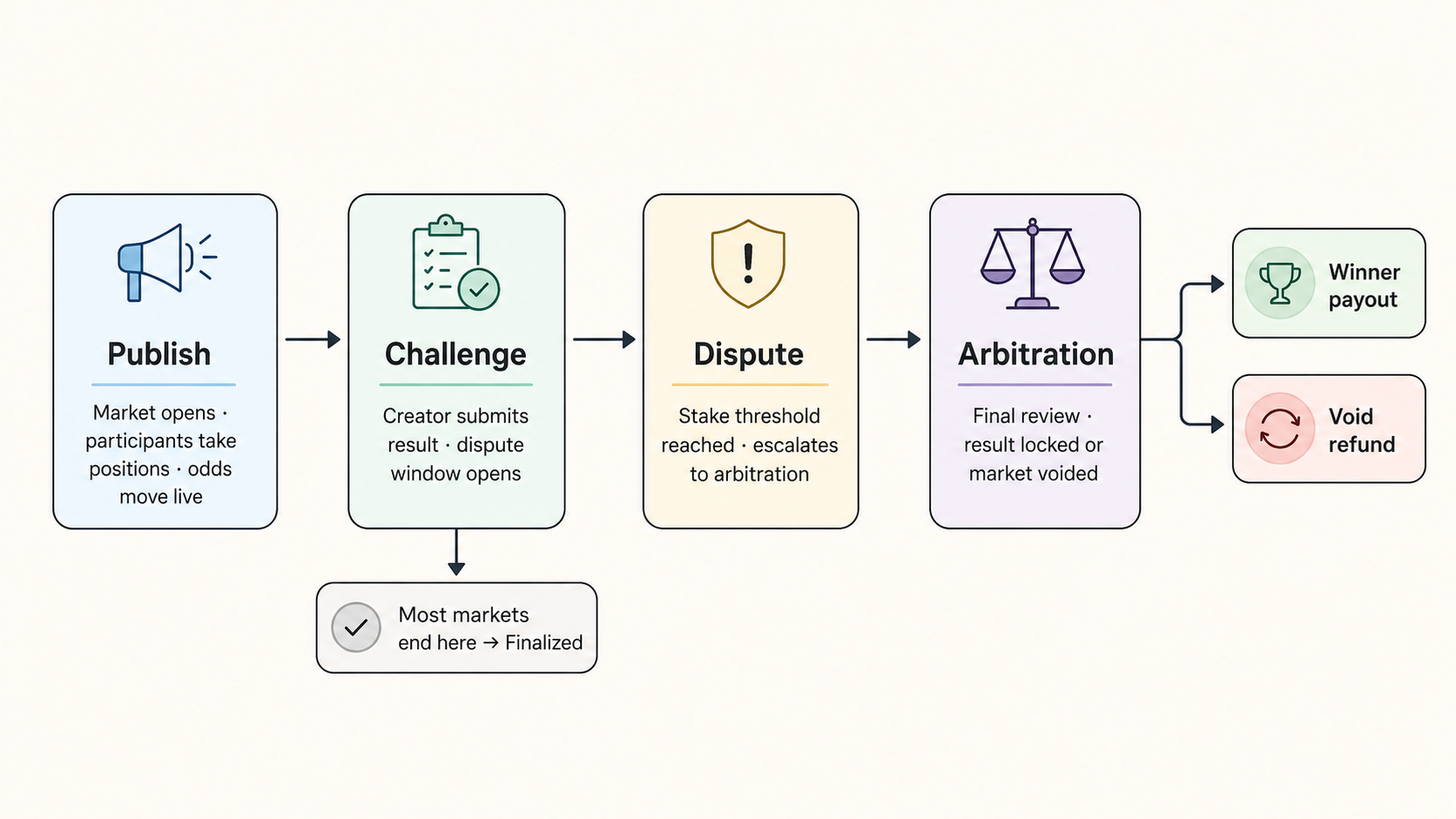
Most markets resolve quietly in the first stage. The later stages exist to ensure that when disputes arise, they are handled with escalating care and accountability.
Stage I — Publish
A creator opens a market with a question, a set of outcomes, and a set of rules. Once the market is live, participants arrive, read the current odds, and take positions. The pool grows with each new participant. Odds shift in real time.
Stage II — Dispute Period
The event occurs. The creator reviews the outcome against the market's rules and submits a result. The dispute period opens.
During this window, any participant who believes the submitted result is wrong can raise a formal dispute. If no one disputes the result — or if disputes do not reach the protocol's economic threshold — the market moves toward finalization with the creator's result intact. Most markets end here, cleanly and automatically.
Stage III — Dispute
If the dispute threshold is met, the market enters the disputed path. Escalation is not triggered by the number of disputers, but by the combined position they represent in a given outcome. Meaningful disagreement, backed by real capital, is what drives the process forward.
Stage IV — Arbitration
For markets where dispute does not resolve the question, arbitration is the final layer. An arbitrator reviews the case and submits a result. This is the protocol's last line of defense.
If even arbitration cannot produce a valid outcome, the market is voided: all net positions are returned to participants in full. The protocol would rather return every cent than assign a result it cannot honestly determine.
Incentives
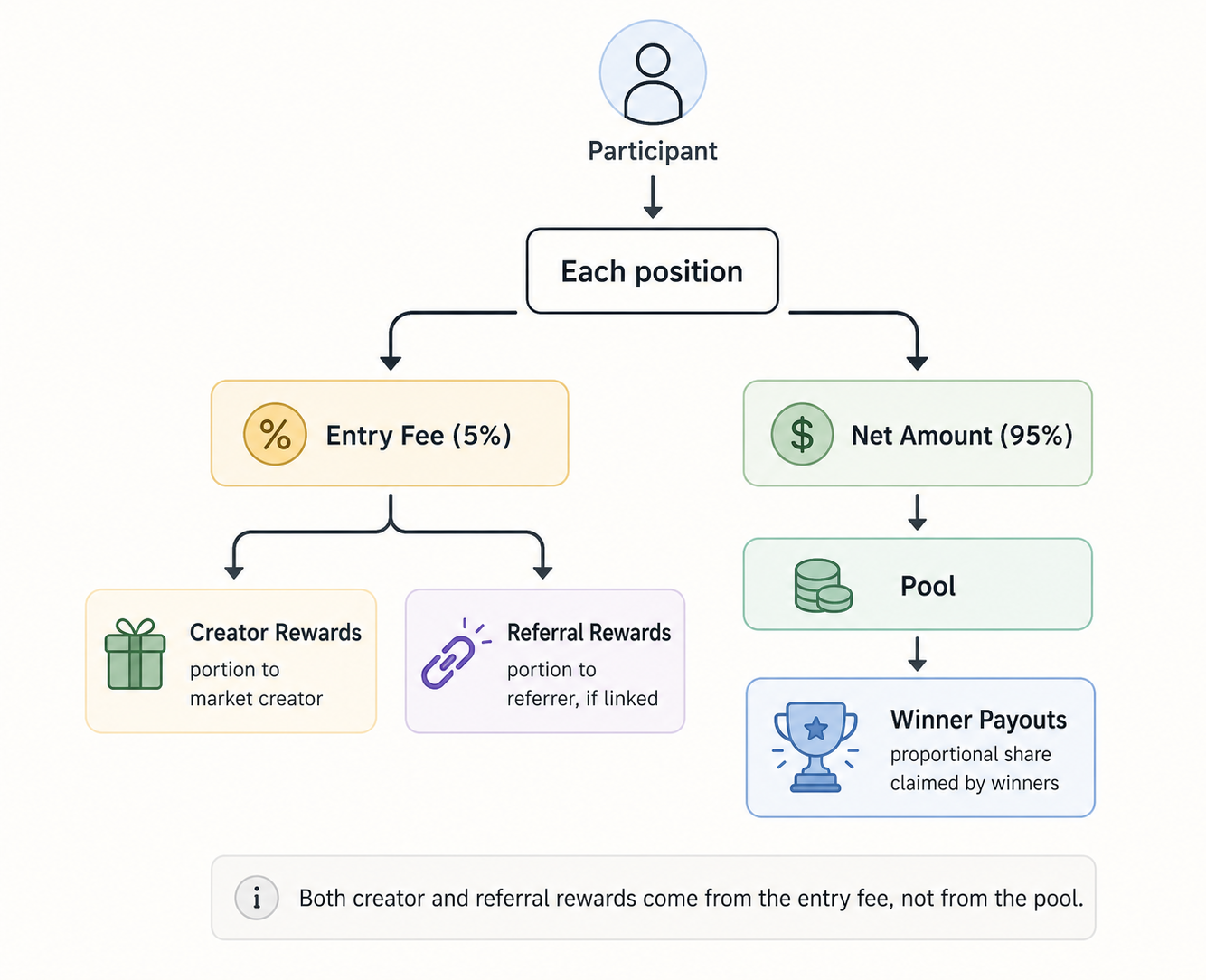
Signa treats growth as something that belongs to its participants, not only to the platform.
Creators earn a share of the entry fees generated by their markets — rewards that accumulate per position placed and become claimable when they fulfill their settlement responsibilities.
Referrers earn from the positions placed by users who enter markets through their referral links — rewards that accumulate per position and are claimable from each market.
Both systems sit alongside the core prediction mechanics, not in place of them.
From question to outcome
The full arc of a Signa market: a question is published, participants commit capital, an event occurs, a result is proposed and tested, and funds are distributed according to the final on-chain outcome.
Every step in that arc — position entry, fee allocation, settlement, dispute, arbitration, payout — happens through on-chain contracts. The record is public. The logic is fixed at market creation. The result belongs to no one and is visible to all.