
Market Lifecycle
A Signa market does not move directly from active trading to claimable proceeds. It follows a lifecycle.
That lifecycle helps users understand where a market is, what actions are still possible, and what should happen next.
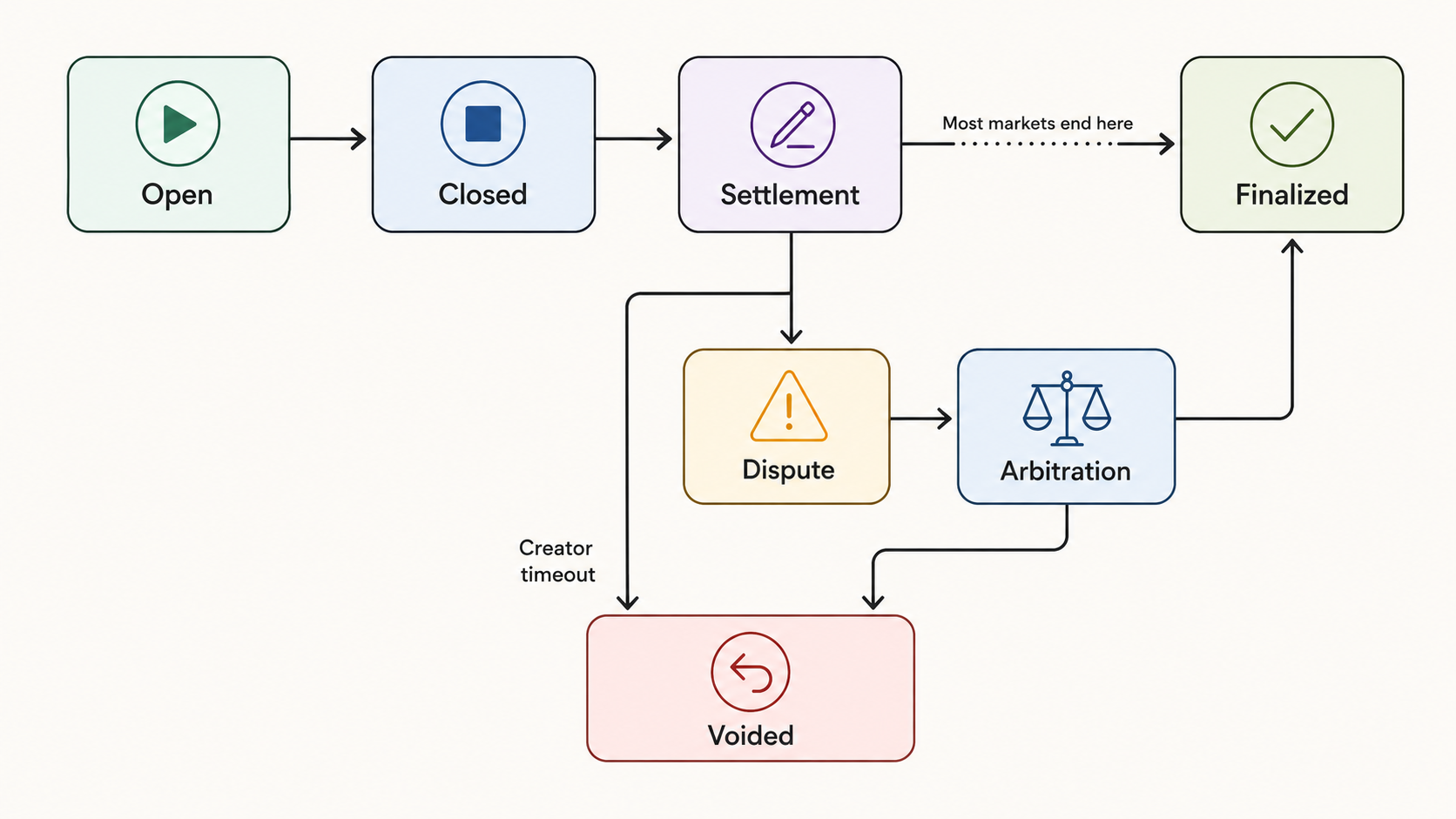
1. Active
The market is live and users can enter positions.
At this stage, the main user actions are:
- reading the market
- choosing an outcome
- entering a position
- sharing the market
2. Settling
When the participation window ends, the market stops accepting new positions and enters the settle window.
After this point, the focus moves away from entering the market and toward determining the final outcome.
3. Dispute Period
Once the creator submits and locks a result, the market enters the Dispute Period. Participants who believe the result is wrong can raise a dispute during this window.
If the combined position backing any single alternative outcome reaches 30% of that outcome's pool, the dispute escalates to arbitration. If no dispute meets the threshold, the market resolves according to the creator's submitted result.
In cases where the creator missed the settlement deadline, a free dispute window applies — any single dispute immediately triggers arbitration, regardless of position size.
4. Arbitrating
Arbitration is the fallback path for disputed markets where the escalation threshold has been reached. An arbitrator reviews the case and submits a final result.
If arbitration cannot produce a valid outcome, the market is voided.
Not every market reaches this stage. Most markets are expected to resolve without arbitration.
5. Resolved
A market is resolved only after the active resolution path is complete. Resolution locks the outcome and allows distribution to proceed based on the final result.
6. Claim or refund
After resolution:
- winners claim payouts when there is a valid winning outcome
- users receive refunds when the market is voided
Why the lifecycle matters
Users should not think of a market only as “trade now, get paid later.” The lifecycle is part of the product itself. It tells users:
- when a position can be entered
- when a result is only proposed
- when a dispute is still possible
- when an outcome is final