
Transparency and Integrity
Signa's trust model does not ask you to take the platform's word for anything that matters. The mechanics that affect your funds — market parameters, participation records, resolution outcomes, and payment logic — are on-chain and verifiable.
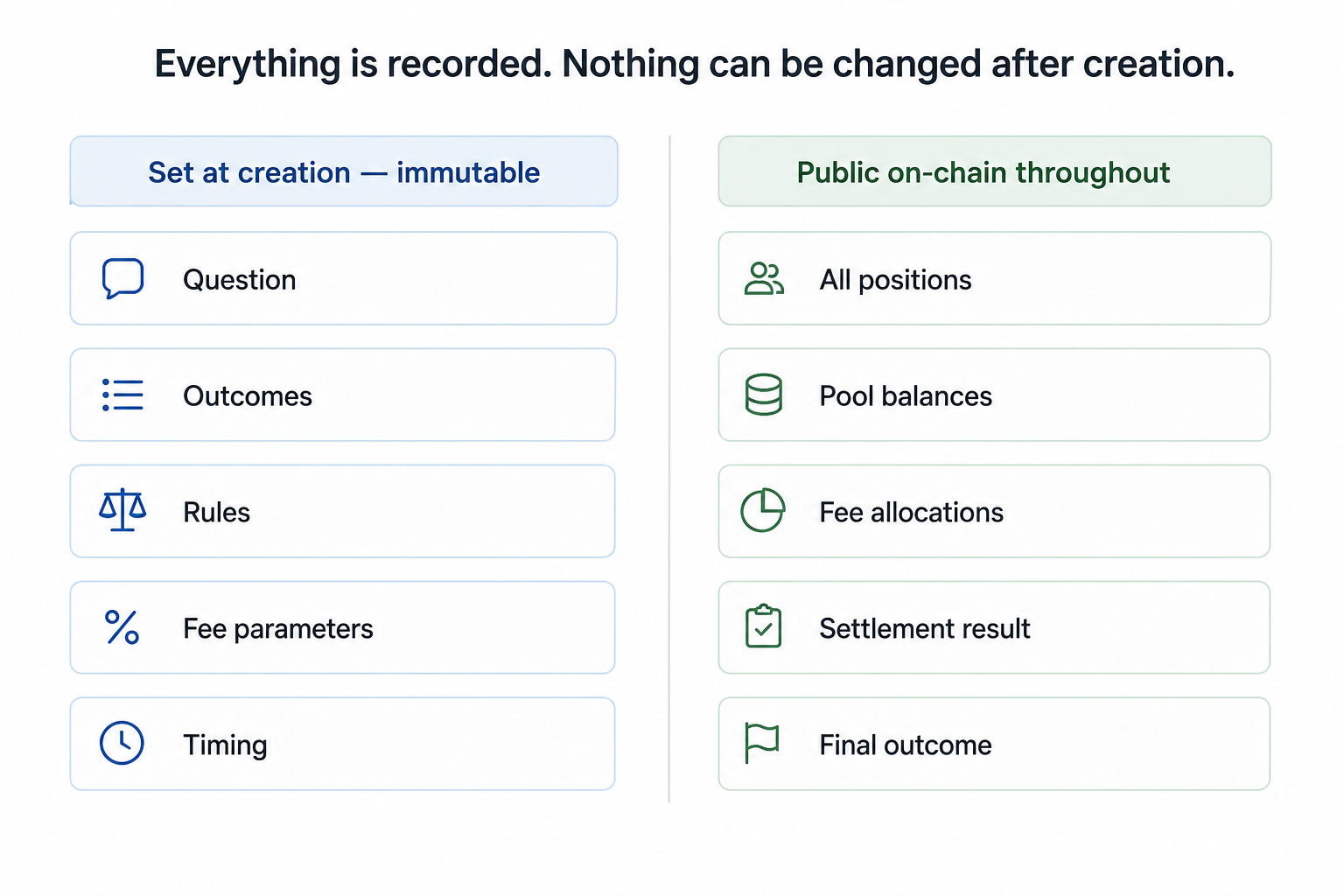
On-chain by design
Signa markets are smart contracts deployed on BSC. Every position placed, every fee allocated, every settlement submitted, and every payout distributed happens through on-chain transactions. The blockchain is the record.
This means you can verify:
- that your position was recorded correctly
- how fees were distributed at the time of your transaction
- what the market's settlement result is and when it was submitted
- what you are owed and whether it has been claimed
You do not need to rely on Signa's interface or Signa's statements to confirm any of these. The data is on the chain.
Immutable market parameters
When a market is created, its core parameters are captured in a snapshot and fixed for the lifetime of that market. This includes the fee structure, the arbitration configuration, the timing windows, and the settlement and dispute parameters.
No one — including the protocol's operators — can alter these parameters after creation. A market you enter today operates under exactly the rules it was deployed with.
This means fee rates, dispute thresholds, and resolution windows cannot be changed mid-market to disadvantage participants.
Resolution integrity
The resolution process is protocol-enforced, not platform-declared. Settlement, dispute, and arbitration follow a defined state machine. Each transition requires on-chain action and meets explicit conditions before it is accepted.
A market cannot skip the dispute window. An arbitration result cannot be submitted after the deadline. A market cannot resolve before the required phases are complete. These are contract-level constraints, not policy documents.
The final outcome of every market is written to the contract. What you can claim is determined by that on-chain state — not by a Signa announcement or dashboard display.
What transparency means in practice
For participants: you can audit your own position, verify the payout math, and confirm that what you received matches what the contract calculates. If the interface shows something different from what the contract says, the contract is correct.
For observers: every market's history is readable from the blockchain. Participation, fees, settlement submissions, disputes, and final outcomes are all part of the on-chain record.
Limits of transparency
Not everything is on-chain, and it is worth being clear about what isn't:
- Market metadata. Categories, cover images, and tags are stored off-chain. They do not affect market mechanics but are not part of the on-chain record.
- Settlement evidence. When a creator submits a settlement, the evidence text and a file hash are recorded in the transaction's event log. The underlying files themselves are stored off-chain. The hash allows verification that the file has not been changed, but the file is not on the blockchain.
- Referral binding. The referral link binding process involves an off-chain step before the on-chain referrer parameter is set. The resulting referrer assignment per position is on-chain; the link visit that triggered it is not.